Most teams never really choose between scrum and kanban. They inherit whatever the last place did, feel a low background friction for a year, and never trace it back to the framework. So before any comparison, here is the question that actually settles it: does your work arrive in batches you can plan, or does it just keep coming?
Hold that question. Everything else is detail.
The short answer
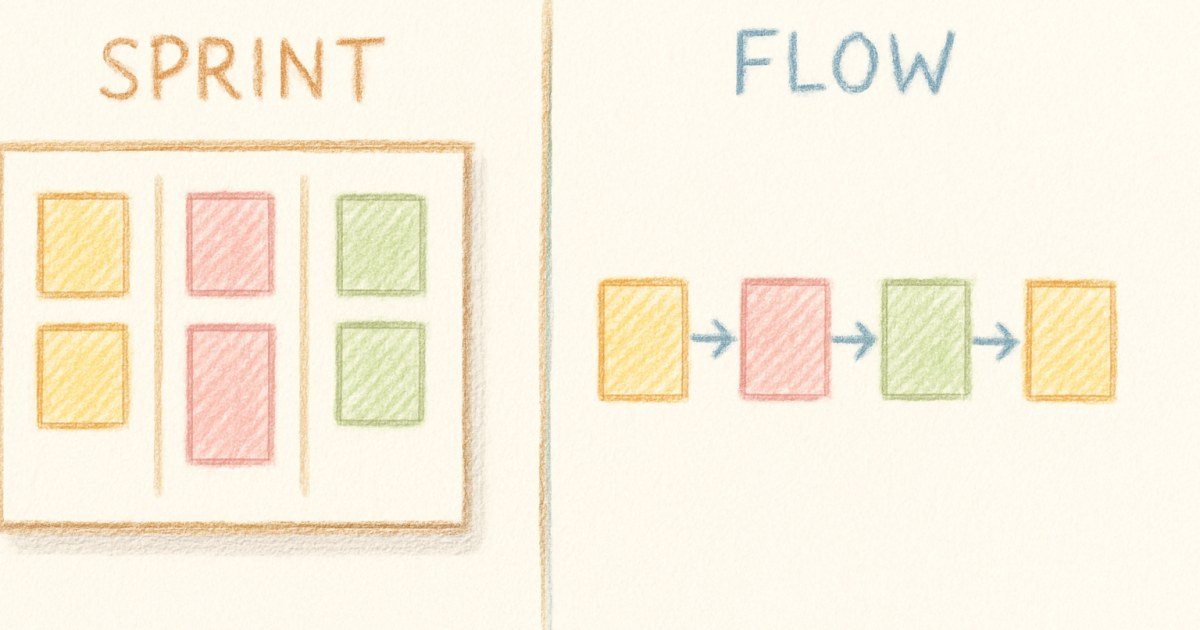
Scrum slices time into fixed-length sprints. You plan a chunk of work, commit to it, build it, then review and repeat on a steady drumbeat.
Kanban does not slice time at all. Work flows across the board continuously, you cap how much can be in progress at once, and you focus on moving each item through as smoothly as possible.
Fixed cadence versus continuous flow. That one difference drives almost everything else.
What scrum actually is
Scrum is a rhythm. It runs in sprints, usually one or two weeks, and wraps a few habits around them: planning at the start where the team pulls a realistic amount of work and agrees a goal, a scope that is protected from mid-sprint churn, and a review and retrospective at the end.
Its strength is predictability. Everyone knows when planning happens, when work ships, and when to bring up new ideas. If your team benefits from a heartbeat and a clear "this is what this sprint is for," scrum gives you that almost for free. It does lean on a refined backlog and a shared sense of size, which is where story points earn their keep.
What kanban actually is
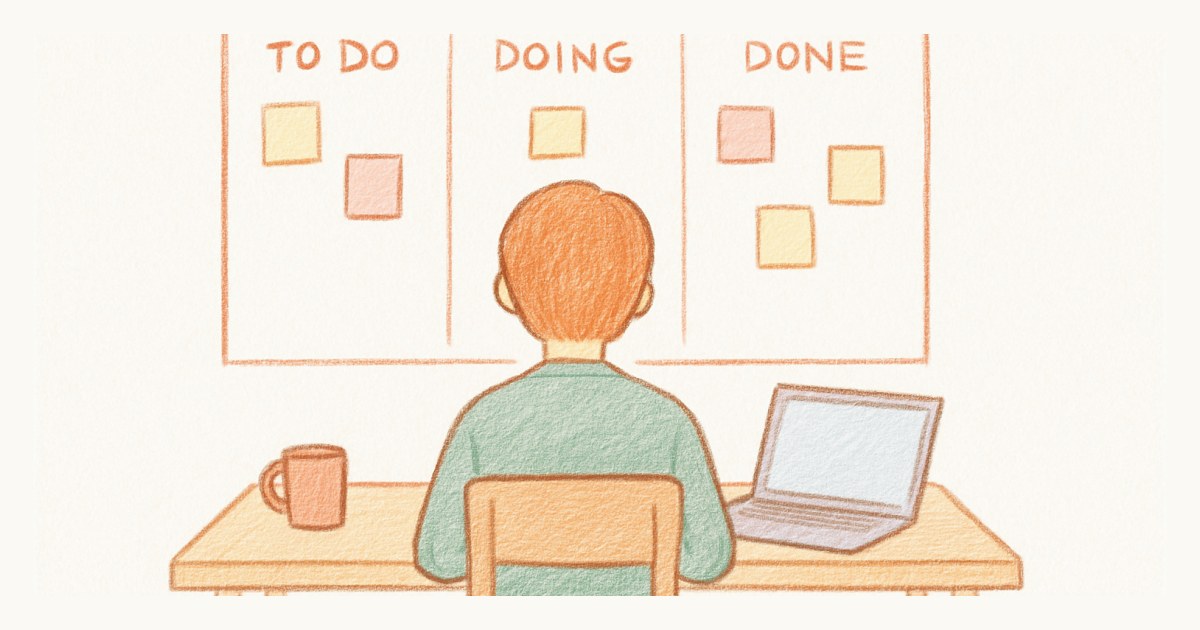
Kanban is a flow. No sprints, no fixed commitment. You make the work visible on a board and add one rule that does a surprising amount of work: limit work in progress. Each column can only hold so many items at once.
That constraint sounds trivial and changes everything. When the "in progress" column is full, you cannot start something new; you have to finish something first. The whole team's attention shifts from starting work to finishing it, which is usually where the real bottleneck was hiding all along.
Kanban measures itself on flow: cycle time (how long an item takes to cross the board), throughput (how many you finish in a period), and the bottlenecks the WIP limits make impossible to ignore.
The real differences, side by side
| Scrum | Kanban | |
|---|---|---|
| Cadence | Fixed sprints | Continuous flow |
| Commitment | A planned sprint scope | Whatever is next in the queue |
| Mid-stream change | Discouraged during a sprint | Expected and easy |
| Key metric | Velocity per sprint | Cycle time and throughput |
| Best when | Work can be planned ahead | Work arrives unpredictably |
When to choose scrum
Reach for scrum when your work can reasonably be planned a sprint ahead and the team benefits from a shared goal. Product teams building features usually fit: there is a roadmap, the work shapes into stories, and a steady cadence keeps everyone pointed the same way. If "what are we focused on this sprint?" is a useful question for your team, scrum is the framework that answers it.
When to choose kanban
Reach for kanban when the work arrives unpredictably and committing two weeks ahead would be a polite fiction. Support, operations, incident response, maintenance: you cannot plan which tickets land on Tuesday, so a continuous flow with WIP limits serves you better than a sprint plan reality has already ignored by Wednesday.
You do not have to pick a side
The quiet truth is that most healthy teams run a blend, usually called Scrumban: keep scrum's cadence, the planning and review that give the week a shape, and borrow kanban's continuous flow to stay sane inside it. Nobody hands out purity awards. Take the parts that help and drop the parts that do not.
Which is also why the framework debate matters less than the tool debate. A tool that forces rigid sprints on you fights back the week your work turns unpredictable. A tool with no concept of a sprint leaves you assembling a plan by hand. Picking one is its own exercise, and the shortlist for a small team is shorter than the marketing suggests. What helps most is a board that runs sprints when you want the cadence and drops them when you do not, without moving to a different tool.
Pick the tool that does not force the choice
That is the bar we set for Scrumpy. There is a single switch for sprints: leave it on and you get scrum, with planning, story points and a velocity view; turn it off and the board becomes a plain, always-on flow you just keep moving work across. Either way it is one clean board, every column on one screen, no sideways scrolling that hides half your workflow, and no consultant needed when your process shifts.
We are honest about the edge: Scrumpy does not enforce work-in-progress limits, so a hardcore kanban team that lives by them will want a dedicated flow tool. But for the far larger group running scrum, or scrum that occasionally wants to breathe like kanban, one board that does both without a migration is usually the whole answer. Run your next sprint on it and switch modes the day your work changes shape.
Frequently asked questions
What is the difference between scrum and kanban?
Scrum organises work into fixed-length sprints with a planned commitment and a regular cadence of planning and review. Kanban has no sprints: work flows continuously, you limit how much is in progress at once, and you optimise for a smooth, fast flow rather than a per-sprint plan.
Is scrum or kanban better for a small team?
It depends on your work, not your size. Choose scrum if you benefit from a regular planning rhythm and a clear goal each sprint. Choose kanban if your work arrives unpredictably, like support or operations, where committing two weeks ahead does not make sense. Many small teams are happiest with a blend.
Can you use scrum and kanban together?
Yes. The blend is often called Scrumban: keep scrum's cadence of planning and review, but use kanban's work-in-progress limits and continuous flow inside the sprint. Plenty of teams land here without ever naming it, taking the useful parts of each.
Do you need story points for kanban?
No. Kanban measures flow, so it cares about how long work takes to move across the board (cycle time) rather than how many points you complete per sprint. Some kanban teams still size work loosely, but estimation is optional in a way it usually is not for scrum.