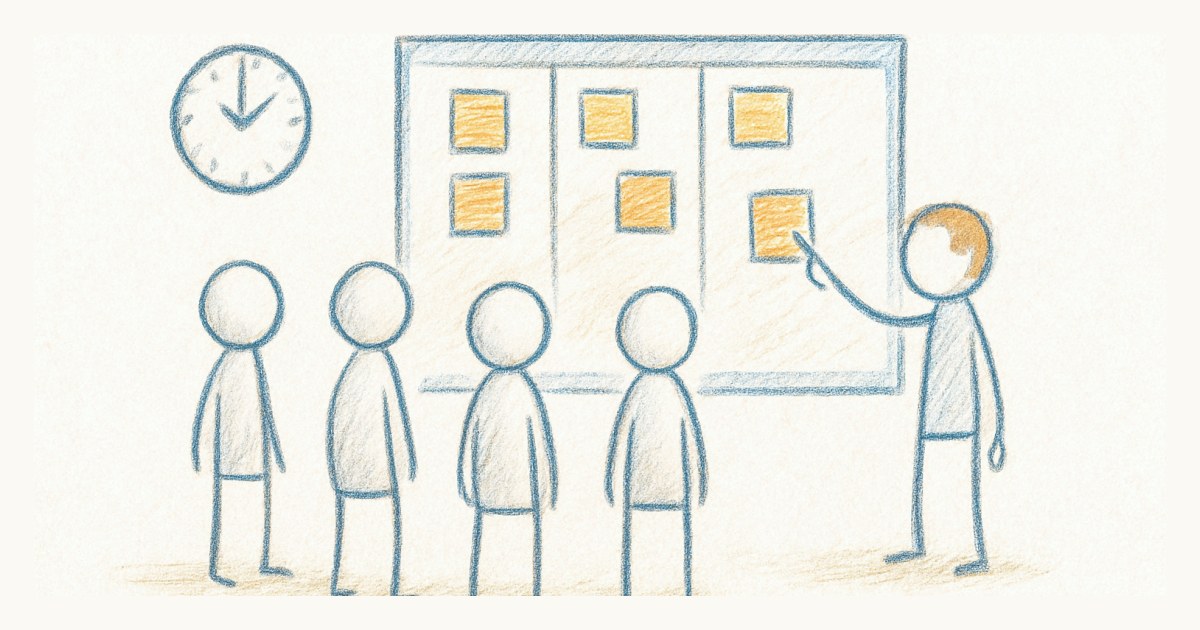
Picture the standup that has quietly stopped working. Nine people in a rough circle, or nine faces in a grid, each one waiting for their turn to say roughly the same three sentences they said yesterday. Someone mentions a ticket number nobody else is tracking. Two engineers slide into a ten-minute design argument while the other seven check their phones. Fifteen minutes becomes twenty-five, and the one person who was genuinely stuck never quite found the gap to say so.
That meeting is not a standup. It is a status report performed for an audience, and it is the version most teams end up with unless they are deliberate about avoiding it.
What a daily standup is actually for
A standup exists to do one thing: help the team coordinate its way to the sprint goal, together, every day. That is the whole purpose. It is not a chance for a manager to check that everyone was busy, and it is not a progress meeting for stakeholders. It belongs to the people doing the work, and its only job is to make the next day's work flow a little better than it would have without it.
Once you hold onto that, the two most common failure modes become obvious. When the standup turns into a round of individual reports aimed at whoever seems most senior, it has stopped coordinating anything. And when it turns into live debugging, it has stopped being short. Both are drift away from the same simple centre: are we on track for the goal, and what is in the way?
The three questions, and why they go stale
Most people learn the standup as three questions. What did you do yesterday? What will you do today? Anything blocking you? As a set of training wheels they are fine. They give a nervous new team a shape to follow.
The trouble is that they quietly reward the wrong thing. Answer them literally and you produce a list of activity: I worked on the login page, I will keep working on the login page. Nobody learns whether the login page is close to done, whether it is stuck, or whether it still matters this sprint. You get motion, not progress.
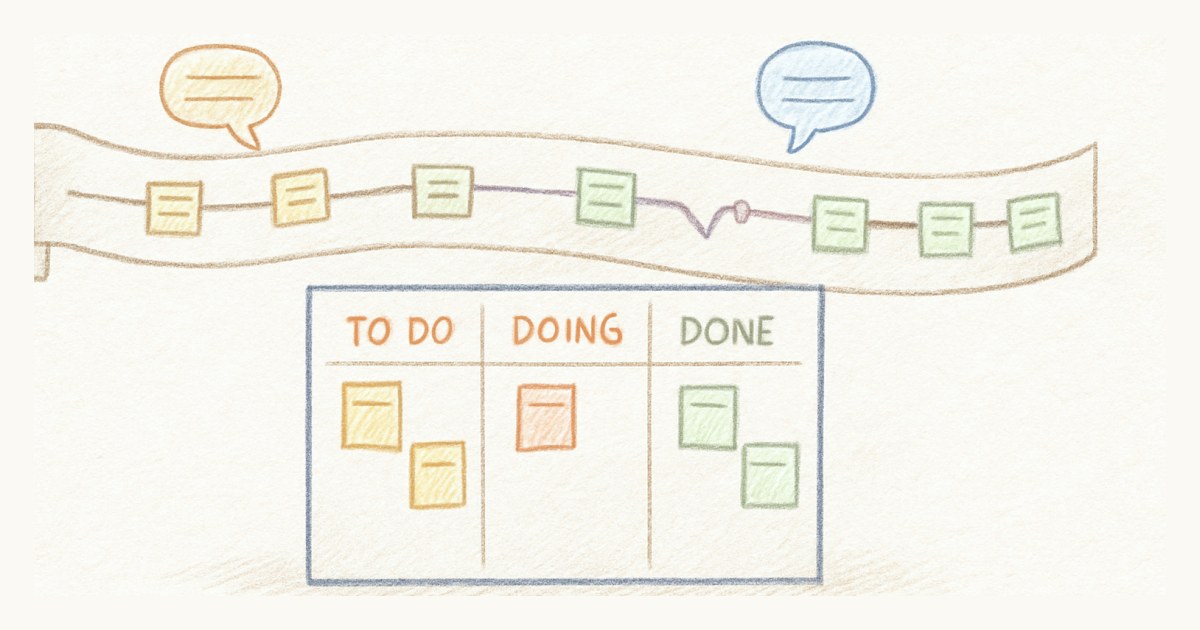
Teams that have run scrum for a while tend to drop the questions and walk the board instead. You start from the story closest to done and move left, asking a different question of each one: what does this need to get finished today? Suddenly the conversation is about work, not people. The quiet story that has sat in review for three days becomes visible, because you are looking straight at it rather than waiting for its owner to confess. This only works if everyone can actually see the board at a glance, which is one honest argument for keeping the whole sprint on one screen instead of scrolling sideways through it.
Keeping it to fifteen minutes
The time cap is not a productivity gimmick. It is what forces the meeting to stay a coordination checkpoint rather than sprawling into everything else. A few habits protect it:
- Start on time regardless. Waiting for stragglers trains everyone to arrive late. Begin at the agreed minute with whoever is there.
- Park the deep dives. The moment two people need to solve something in detail, name it, note who is involved, and move on. The phrase "let's take that after" is the single most valuable thing a facilitator can say.
- Talk about blockers, not biography. Yesterday's activity only matters if it changes what happens today. If it does not, skip it.
- Keep it small. A standup works at five to nine people. Past that, the arithmetic alone breaks the cap, and it is usually a sign the group should be two teams.
None of this needs a stopwatch or a talking stick. It needs a facilitator who is comfortable gently interrupting, and a shared understanding that cutting a tangent short is a kindness to the other seven people in the room. That facilitator does not have to be a dedicated hire, which is its own question worth asking honestly.
Blockers are the actual point
If a standup does nothing else, it should surface blockers fast. A blocker raised on Tuesday morning and cleared by Tuesday afternoon might save two days of quiet stalling. That single function justifies the meeting on its own.
So make raising one feel safe and normal, not like an admission of failure. When someone says they are stuck, the team's job is not to solve it on the spot in front of everyone, but to make sure the right two people connect the moment the standup ends. A team where "I'm blocked" is met with a quick "I'll help you after this" is a team that will finish more than one where everyone quietly wrestles alone until someone notices.
Remote and async standups
A distributed team does not need to give up the standup, only to adapt how it runs. A short video call at a fixed time works well and keeps the human read on how people are doing. When time zones make that cruel, an async standup in a shared channel is a legitimate alternative: everyone posts a brief note, blockers get flagged, and follow-up conversations spin off from there.
The test is the same either way. Do blockers still surface within a day, and can the whole team see the real state of the work without asking? If your board updates in real time, an async standup is far less lossy, because the channel carries the exceptions while the board carries the truth. The format is negotiable. The fast flow of blockers is not.
Let the board carry the status
The deepest fix for a bad standup is to stop using the meeting to transmit information the board should already show. If everyone can see what is in progress, what is stuck, and what is nearly done before anyone opens their mouth, the standup gets to skip the recitation entirely and spend its fifteen minutes on the two or three things that genuinely need a human decision.
That is the standup we designed Scrumpy around: the whole sprint on a board you can take in at a glance, updating live as people move cards, so the daily sync is a quick conversation about finishing work rather than a performance of having done some. Get the board right and the meeting almost runs itself. If your standups have been creeping toward half an hour, try walking a clear board tomorrow and see how much of the old ritual you simply do not need. When the goal itself is fuzzy, the fix is upstream, in a tighter sprint planning session, not in the standup.
Frequently asked questions
What is a daily standup?
A daily standup is a short meeting, ideally fifteen minutes or less, where a team briefly syncs on progress toward the sprint goal and surfaces anything blocking that progress. It is a coordination checkpoint, not a status report to a manager.
How long should a daily standup be?
Fifteen minutes is the standard cap, and most teams of five to nine people can comfortably stay under it. If yours regularly runs longer, that is usually a sign the meeting has turned into detailed problem-solving that should move to a smaller follow-up conversation instead.
What are the three questions in a daily standup?
The classic three are: what did you do yesterday, what will you do today, and is anything blocking you. They are a useful starting scaffold, but many experienced teams drop them and instead walk the board story by story, which keeps the focus on finishing work rather than reciting activity.
Do remote teams still need a daily standup?
Yes, though the format can flex. Remote teams can run the standup as a quick video call at a fixed time, or async in a shared channel, as long as blockers still surface quickly and the whole team can see the current state of the board. The purpose is unchanged; only the delivery differs.