The retrospective is the ceremony teams quietly give up on first. It is easy to see why. Done badly, it is a weekly airing of the same three complaints, nodded at, written on a board, and forgotten by the next afternoon. After a few rounds of that, people stop bringing anything real, the meeting becomes a polite half-hour of "yeah, fine, good sprint," and its one genuine power, the chance for a team to get better on purpose, drains away.
That is a shame, because the retrospective is the only ceremony whose entire job is improvement. Skip it and you keep whatever is broken.
What the retrospective is for, and what it is not
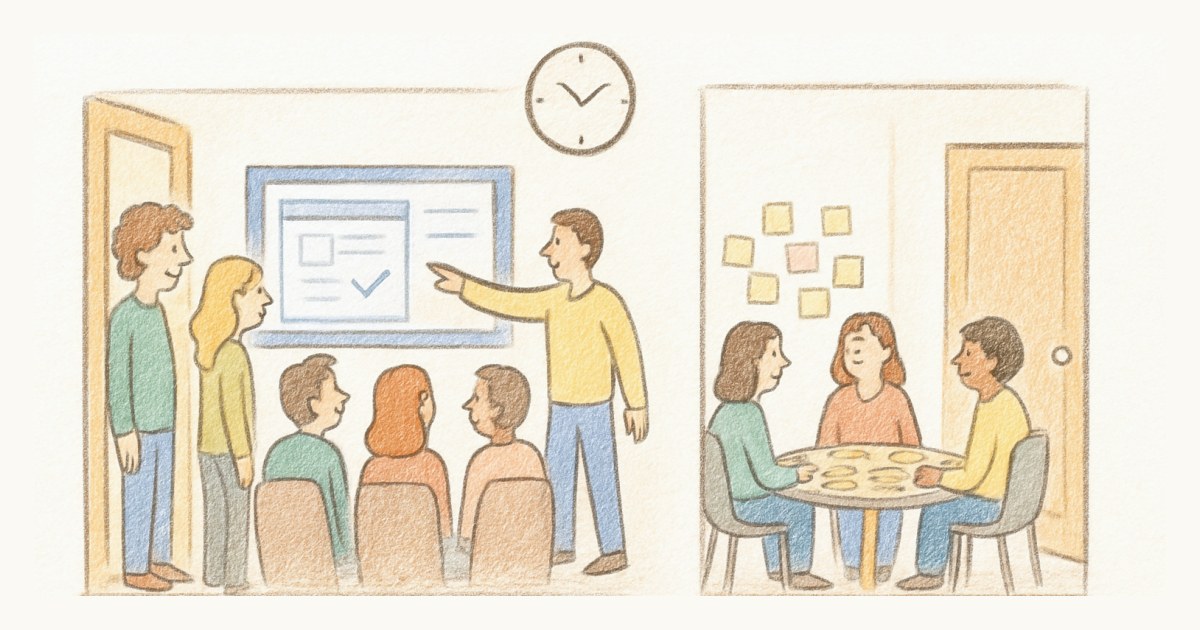
A retrospective is the team looking inward at how it worked over the last sprint, so it can choose to work a little better in the next one. Not the product, the process: how you planned, how you communicated, where things stalled, what quietly cost you a day. It is easy to confuse with the sprint review, so it is worth being precise. The review faces outward and asks whether you built the right thing. The retrospective faces inward and asks whether you built it in a good way. Different audience, different question, different meeting.
Held to that purpose, the retrospective is not a venting session and not a search for someone to blame. Venting feels productive and changes nothing. Blame ends honesty on the spot. The measure of a good retrospective is not how much got said, but whether the team walks out with something it has genuinely agreed to do differently.
A format that reliably works
You do not need an elaborate technique or a deck of themed activities. A plain three-part shape carries most teams a long way:
- What went well. Start here, and mean it. Naming what worked is not filler; it tells the team what to keep, and it sets a tone where honesty is not just criticism.
- What did not go well. The problems, stated plainly. The facilitator's job is to keep this about situations and systems, not people, so it stays safe to be honest.
- What we will change. The whole meeting bends toward this. Turn the discussion into one or two specific things to try next sprint, each with an owner.
Rotating the exact framing keeps it from going stale, and there are dozens of variations, but almost all of them are this arc in a costume: reflect honestly, then commit to something small. If you only ever run the plain version, you will still get most of the value.
The one rule that makes it honest
None of it works without safety. If people believe that naming a problem will be held against them, or that pointing at a broken process will be heard as pointing at a person, they will say nothing true and the meeting becomes theatre.
So the load-bearing rule is that a retrospective is blameless. You talk about what happened and why the system allowed it, not about whose fault it was. "The deploy broke on Friday and we lost the afternoon" is a fact the team can learn from. "You broke the deploy" is an accusation that guarantees the next person hides their mistake. The facilitator protects this line constantly, and quietly redirecting a comment from a person to a situation is most of the skill of running the meeting. Get safety right and the honesty takes care of itself. Get it wrong and no clever format will save you.
Turn talk into one or two real changes
Here is where most retrospectives leak all their value: the discussion is fine, and then nothing happens. The list of problems gets longer every sprint and the list of changes stays empty, and eventually everyone notices that the meeting does not lead anywhere. The complaints that come back every time deserve the most attention: stories that spill into the next sprint every sprint are a pattern to fix, not bad luck to shrug at.
The fix is discipline about the output, not the input. Two habits do most of the work:
- Pick very few actions. One or two changes the team can actually make next sprint beats ten aspirations it will not. A retrospective that produces a single improvement every sprint compounds into a very different team over a quarter.
- Give each action an owner and a home. A change with no name attached is a change nobody makes. Put it somewhere you will see it, ideally as an item near the top of your backlog or your board, so it competes for attention alongside the real work instead of dying in a meeting note.
Then, at the start of the next retrospective, look at whether the last change actually happened. That one loop, deciding something and then checking on it, is what separates a team that improves from a team that just meets.
Keep the momentum small and real
The retrospective earns its place when it is light, honest, and followed through. A team that reliably fixes one small thing each sprint will, within a few months, be working in a way it could not have designed up front. That is the quiet compounding the ceremony is for, and it only happens when the changes are small enough to actually land.
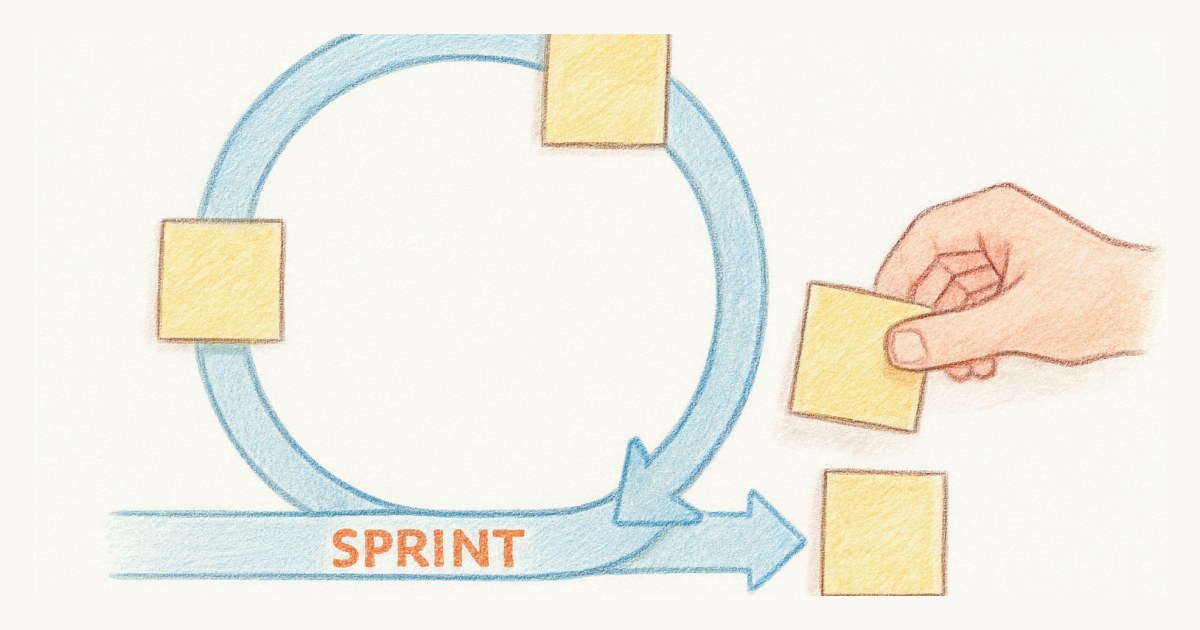
Whether you run full scrum or a more continuous kanban-style flow, the reflex is the same: stop now and then, look at how the work is really going, and change one thing. If your retrospective actions currently vanish into a document nobody reopens, try parking the next one as a visible card on a board the whole team can see, right beside the work it is meant to improve. A change you can see is a change you might actually make.
Frequently asked questions
What is a sprint retrospective?
A sprint retrospective is a short meeting at the end of a sprint where the team reflects on how it worked, not what it built, and picks a small number of concrete changes to try next sprint. It is about the process and the people, and it is owned by the whole team.
How long should a sprint retrospective be?
For a two-week sprint, forty-five minutes to an hour is typical and usually enough. The length matters less than the focus: a good retrospective ends with one or two agreed changes, and a longer meeting that ends with a vague list of grievances has achieved less than a short one that ends with a decision.
What questions do you ask in a retrospective?
A reliable starting set is: what went well, what did not, and what will we change. Many teams vary the framing to keep it fresh, but the underlying arc is the same, moving from honest reflection to a small, specific commitment the team can actually act on next sprint.
What is the difference between a retrospective and a sprint review?
A sprint review looks outward at the product: the team shows the work to stakeholders and gathers feedback on what was built. A retrospective looks inward at the way the team works: how it collaborated, where it got stuck, and what it wants to change. Review is about the product, retrospective is about the process.