Planning poker,
without the sign-up
Start a room, share the link, and everyone's cards turn over at the same moment. No account, no ads, no five-person limit that appears at the worst time.
Rooms delete themselves about twelve hours after the last person leaves. We keep no copy.
How a session runs
- 1
Start the room
Type your name, pick a deck, and you have a room. There is no account to create and no email address to hand over.
- 2
Share the link
Copy the room URL into your call or your team chat. Anyone who opens it types a name and sits down — on a laptop or a phone.
- 3
Everyone plays a card
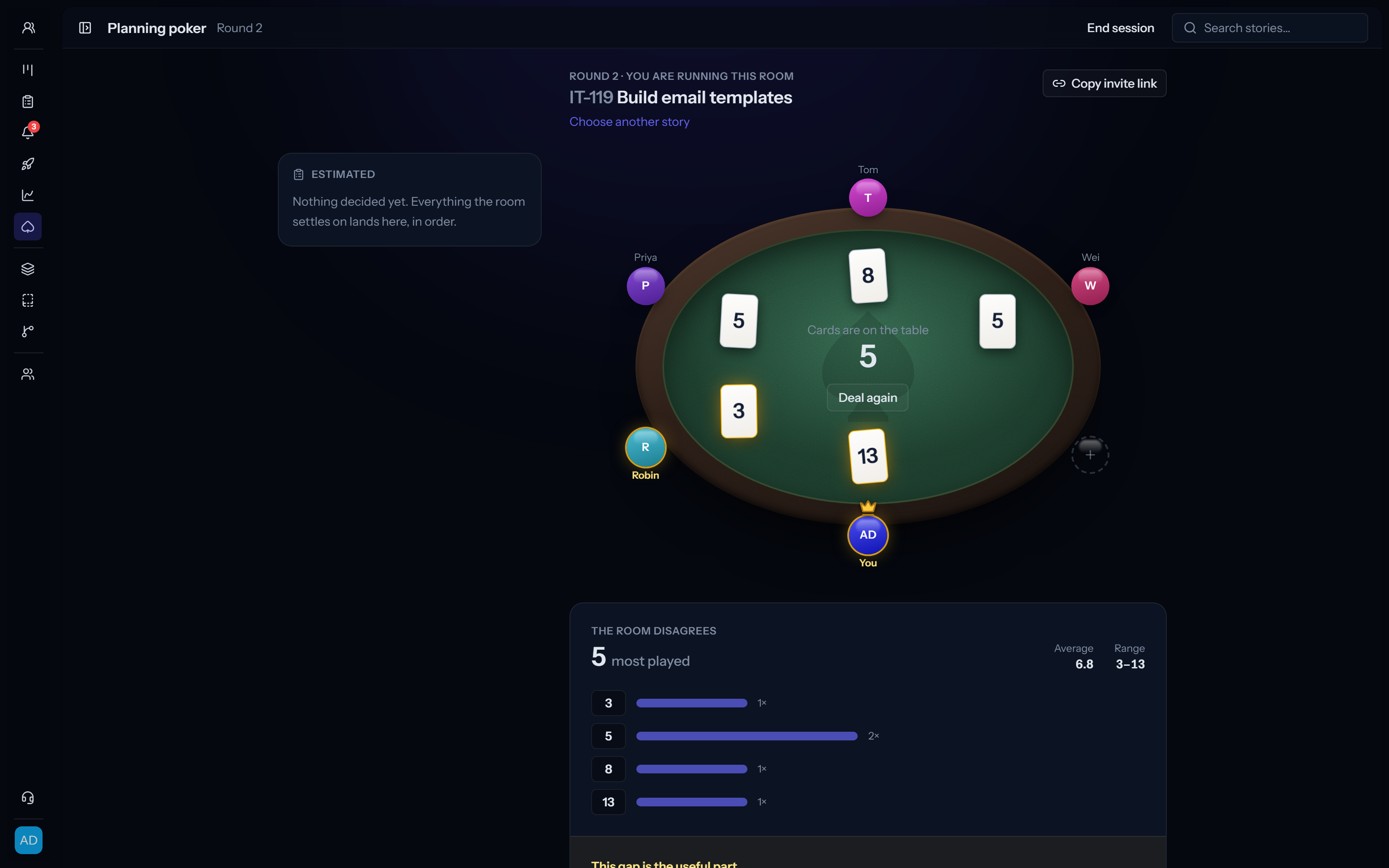
Cards stay face down while people choose, so nobody anchors on the first number said out loud. The table shows who has played, never what.
- 4
They turn over together
The moment the last person plays, every card flips at once. You get the spread, the average and the card most of the room chose.
What planning poker is for
Planning poker is a way of estimating work in which everybody commits to a number privately and then reveals it at the same time. That simultaneous reveal is the whole mechanism. Ask a team to estimate out loud and the first number spoken drags every other number towards it — usually the number from whoever is most senior, or most confident, or simply quickest to speak.
The output people think they are after is the estimate. The output that actually matters is the disagreement. When one person plays a 2 and another plays a 13, they are not doing arithmetic differently: they are looking at two different pieces of work. Finding that out before the sprint starts is worth more than any number the room eventually agrees on.
Which is also why we suggest a card rather than deciding for you. This tool shows you the spread, the average and the card most of the room played, and then leaves the decision where it belongs.
Running one well
- Anchor on a reference story. Agree that one finished piece of work everyone remembers is a 3, and size everything against it. Points without an anchor drift within a couple of sprints.
- Talk to the outliers first. Ask the highest and the lowest card what they saw. You are looking for the hidden assumption, not the average.
- Time-box the discussion. Two minutes, re-vote, move on. A third round almost never changes the number, it just costs the room its attention.
- Split anything above a 13. A card that big is the team saying it does not understand the work yet. Break it up rather than estimating it harder.
- Do not poker every story. Most items are obvious to everyone. Save the cards for the ones that split the room.
Frequently asked questions
Is this planning poker tool really free?
Yes, completely. There is no account, no email address, no trial that expires and no card limit. It is made by Scrumpy, a paid scrum tool, and it exists so that people who have never heard of us meet us doing something useful rather than selling.
Do I need to sign up or install anything?
No. Start a room, share the link, and everyone joins in their browser by typing a first name. There is nothing to install, no extension, and no invitation flow.
How many people can join one room?
As many as you need. Planning poker stops working as a conversation long before it stops working as software — if a dozen people are voting, the problem is the meeting, not the room.
What happens to our data?
A room holds the names people typed, the cards they played and whatever you called the item. It deletes itself about twelve hours after the last person leaves. Nothing is sold, nothing is used to profile you, and there are no third-party trackers on the page.
Can we use it for remote and hybrid teams?
That is what it is for. Put the link in the meeting chat and everyone votes from wherever they are. The simultaneous reveal matters more remotely than in a room, because on a call the loudest estimate arrives first and quietly becomes the answer.
What do the numbers actually mean?
Story points are relative sizes, not hours. A 5 is roughly five times the size of a 1, and the value is the comparison rather than the number. If your team is arguing about whether something is a 3 or a 5, you have already got what you came for.
Is this the same as planning poker inside Scrumpy?
It is the same room. Signed-in Scrumpy teams get it with their own point scale on the cards, their backlog on the table, and the agreed estimate written straight onto the story when the round ends. The public version is that room without the backlog behind it.
The estimate has to land somewhere
In Scrumpy, this same room sits next to your backlog: your own point scale on the cards, your stories on the table, and the agreed number written onto the story the moment the round ends. Flat price per editor, free seats for everyone who only watches.