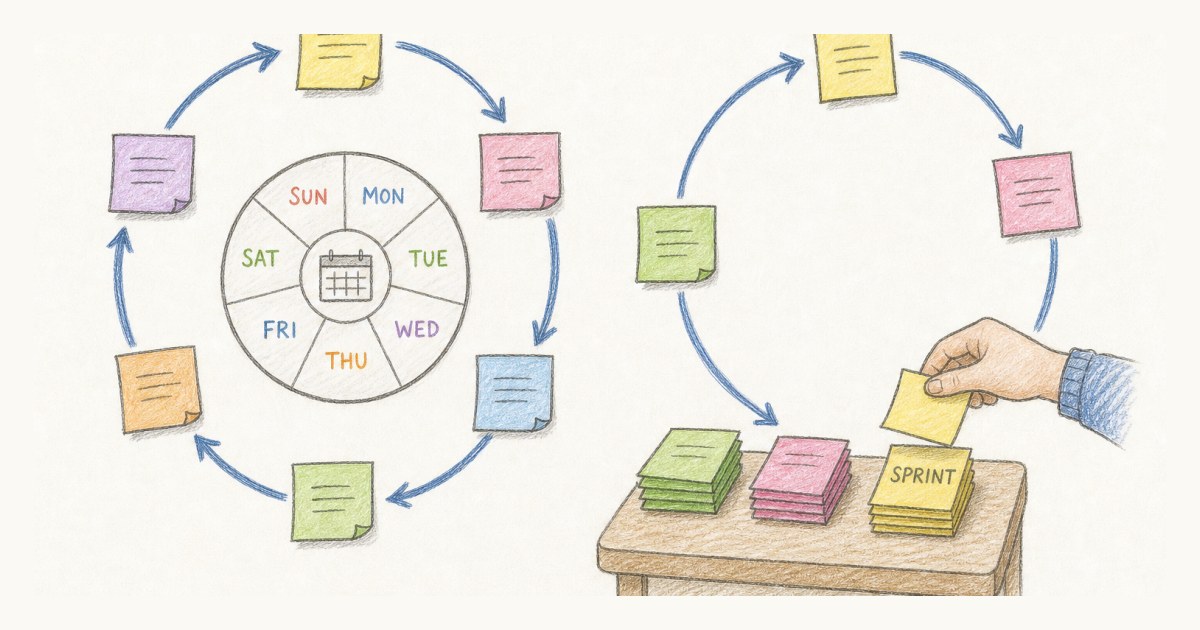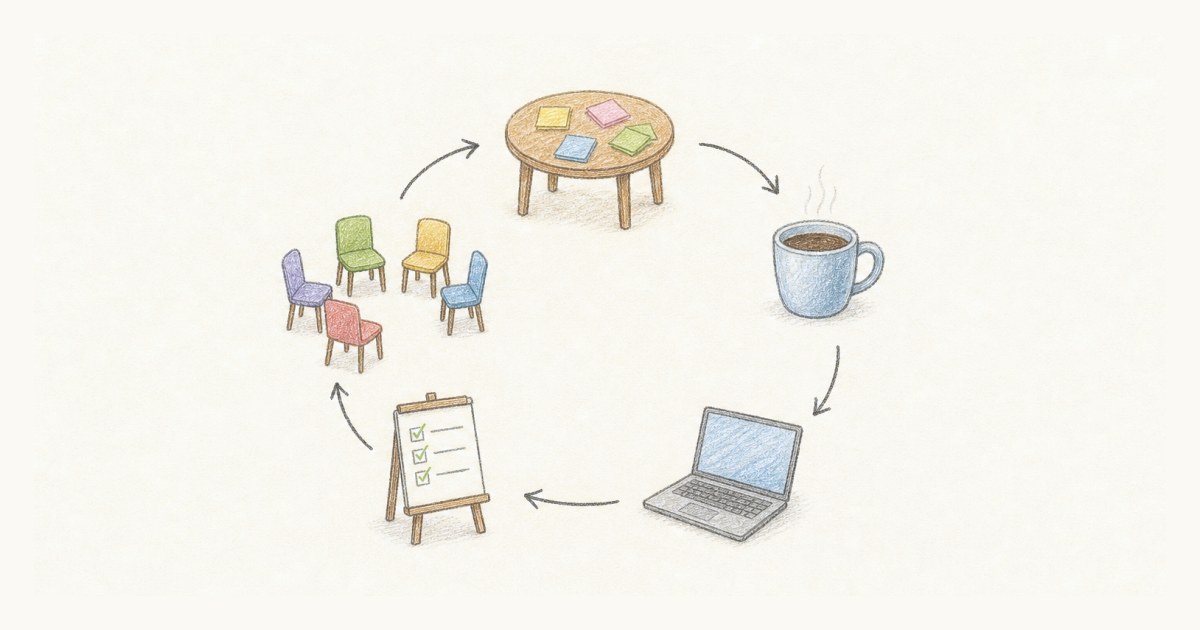
A sprint cycle is one sprint from the first minute of planning to the last minute of the retrospective, and then, with no gap at all, the next one. That last part is in the Scrum Guide in so many words: a new sprint starts immediately after the previous one ends. Most explanations stop at listing the five events. The part worth looking at is what happens between them, because that is where the cycle usually breaks.
Here is what a two-week sprint cycle looks like when you lay it out over ten working days, with real hours attached.
What happens in a sprint cycle?
The 2020 Scrum Guide defines the sprint as the container for four events: Sprint Planning at the start, a Daily Scrum every day, and a Sprint Review followed by a Sprint Retrospective at the end. Backlog refinement runs alongside, but the guide treats it as an ongoing activity rather than an event.
Spread across a typical two-week sprint, starting on a Monday, it looks like this.
| Day | What happens | Time it takes |
|---|---|---|
| Monday, week 1 | Sprint Planning, then work starts | Up to 4 hours |
| Tuesday to Friday | Daily Scrum, building | 15 minutes a day |
| Monday to Thursday, week 2 | Daily Scrum, building, one refinement session for upcoming work | 15 minutes a day, plus refinement |
| Friday, week 2 | Sprint Review, then Sprint Retrospective | Up to 2 hours, then up to 1.5 hours |
| Monday, week 3 | The next Sprint Planning | Up to 4 hours |
The four and two and one and a half hours are not in the guide as such. It gives timeboxes for a one-month sprint (eight hours of planning, four of review, three of retrospective) and says shorter sprints usually get shorter events. Halving them for two weeks is the common reading, and treat those numbers as ceilings. A team that plans in ninety minutes is not doing it wrong.
How much of a sprint cycle goes to meetings?
Add it up for one person. Up to four hours of planning, nine Daily Scrums at fifteen minutes is two and a quarter hours, up to two hours of review and an hour and a half of retrospective. Call it nine and three quarter hours at the ceiling, which is a little over one working day out of ten.
Refinement comes on top. The 2017 edition of the guide said it usually took no more than ten percent of the team's capacity, roughly another day in a two-week sprint. The 2020 edition dropped the number, sensibly, because a team about to start a new product needs far more refinement than one maintaining a mature one.
So the honest figure is that a team running every event to its limit spends around two days in ten on the cycle itself. That sounds like a lot until you look at what the alternative usually costs: the unplanned Slack thread, the "quick sync" that becomes a standing meeting, the two people who built the same thing because nobody planned. The events are the scheduled version of conversations a team has anyway.
What two days in ten should not be is padding. If your events regularly hit the ceiling, the fix is usually upstream. A planning session that runs four hours is almost always a refinement problem, stories arriving too big or too vague to estimate, which our sprint planning checklist and backlog refinement guide both dig into.
Which part of the sprint cycle breaks most often?
Not any of the events. The joint between them.
Look at the end of the table again. The retrospective happens on Friday afternoon. The next planning happens Monday morning. The retrospective's whole output is a change the team wants to make, and the only place that change can actually land is the next sprint's plan. Between the two sits a weekend, and in most teams, nothing that carries the decision across.
So on Monday, planning starts from the backlog, as it always does, and the retro action stays in a document nobody opens. Three sprints later, the same complaint comes up in the retrospective, and someone says "didn't we talk about this already". We wrote about that leak in the retrospective guide; the cycle view makes the cause plain. The retrospective and the next planning are one conversation split over a weekend.
The fix is boring and works. The first agenda item of every Sprint Planning is the retrospective's action, and if it needs time or a story, it goes into the sprint like any other work. Same for the review: if the stakeholders said something on Friday that changes priorities, the product owner reorders the backlog before Monday, not during planning.
What happens to unfinished work at the end of a sprint?
Here the guide and most tools part ways, ours included, and it is worth being straight about it.
The Scrum Guide says that work which does not meet the Definition of Done cannot be presented at the review and returns to the Product Backlog for future consideration. Back to the backlog, not into the next sprint. The point is that the next planning re-decides it, alongside everything else, instead of it arriving pre-committed.
Scrumpy does not do that by default. When you end a sprint, unfinished stories move straight into the next planned sprint, and the sprint report records them as carried over with their points, so the spillover stays visible instead of quietly vanishing. We chose that because rolling stories over is what most teams do in practice, whatever the guide says, and if it is going to happen, recorded beats invisible.
But the guide's version has a real argument behind it. A story that rolls over by default skips the question of whether it still matters. So whatever your tool does, ask it out loud in the next planning: given what we know now, would we pull this story in if it were new? If the answer is no, it goes back to the backlog. If the same stories keep rolling over, that is a pattern, and sprint spillover is usually telling you something about story size or about how much the team commits to.
How long should one sprint cycle be?
One month at most, by the guide. Two weeks is the common default, and it is the length this post walks through because it is the one most teams start with. It is not automatically the right one; choosing between one, two and four weeks depends mostly on how fast your stakeholders can give you feedback and how much of your week gets eaten by interruptions.
One naming note, since it confuses people searching for this: Linear calls its timeboxes cycles. They are close to sprints but not the same thing, mainly because a cycle has no review or retrospective built in, which we compared in Linear cycles vs sprints.
Seeing the cycle while you are in it
The events tell you where the cycle is on the calendar. They do not tell you where the work is. That is the board's job, and it does it best when the whole sprint fits on one screen you can take in at a glance, with a burn-up that shows on Wednesday of week two whether Friday's review will have a finished increment in it.
If you want to see what that looks like mid-cycle, the demo has a sprint in progress, and you can poke at it without signing up. Then run your next retrospective with one rule: whatever it decides is the first thing on Monday's planning agenda. That single habit fixes more sprint cycles than any tool does.
Frequently asked questions
What is a sprint cycle in scrum?
A sprint cycle is one full sprint from start to finish: Sprint Planning, the daily work with a 15-minute Daily Scrum, then the Sprint Review and the Sprint Retrospective. The 2020 Scrum Guide caps a sprint at one month, and a new sprint starts immediately after the previous one ends, so the cycles run back to back with no gap between them.
How long is a sprint cycle?
A sprint cycle lasts one month or less, and two weeks is the most common choice. Within that, the Scrum Guide timeboxes Sprint Planning at up to eight hours, the Sprint Review at up to four hours and the Retrospective at up to three hours for a one-month sprint, with shorter sprints usually getting shorter events. The Daily Scrum is 15 minutes regardless of sprint length.
What happens to unfinished stories at the end of a sprint?
The Scrum Guide says work that does not meet the Definition of Done returns to the Product Backlog for future consideration, so it is not automatically part of the next sprint. In practice many tools and teams move unfinished stories straight into the next sprint. Either way, the honest move is to re-decide each one in the next Sprint Planning rather than letting it roll over by default.
Is backlog refinement part of the sprint cycle?
Backlog refinement happens during the sprint cycle but is not one of the formal scrum events. The 2020 Scrum Guide describes it as an ongoing activity of breaking down and defining Product Backlog items. The 2017 edition said it usually took no more than 10 percent of the team's capacity; the 2020 edition dropped that number.